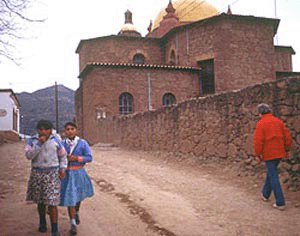
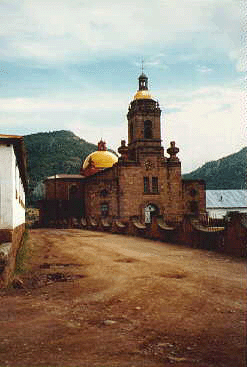
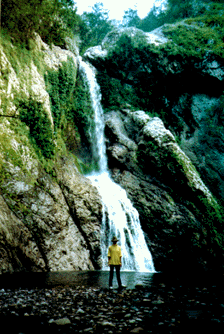
Cerocahui This quaint mountain town is nestled in a peaceful valley. It is know for it's beautiful mission and nearby waterfalls. There a plenty of trails for hiking. It is also the jumping of point to a beautiful viewpoint of Urique Canyon as well as the road down to the bottom to Urique Canyon. SEE A VIDEO
A wonderful virgin landscape setting in the midle of the mysterious Tarahumara
Indian country. The charming village of Cerocahui is located at the edge of
Urique Canyon —the deepest canyon in the system— in a valley dotted with apple
orchards
The village is about 8 miles from the Bahuichivo train station where the Chihuahua
al Pacifico stops daily. The 900 inhabitants experience a way of life many of
us yearn to live
Cerocahui is an "ejido" (government-established community cooperative)
dedicated to forestry. Additional occupations are ranching, farming and service
businesses such as grocery stores. Mining once provided employment but the last
local mine, the Sangre de Cristo, folded in 1963
Cerocahui was first visited by outsiders in 1679 when the Jesuit Padre Pecoro
stayed here for a short period and reported the Indians were not ready to accept
his faith. On the 23 of November 1680 the Jesuit priest father Juan Maria de
Salvatierra arrived in Cerocahui.
The enthusiastic Italian priest began the teaching of Christianity and started
construction of the mission church. He remained in the area for 10 years then
went on to found the Church at Loreto, the first mission established in Baja
California
The Jesuits continued their work in Cerocahui until 1767 when they were recalled
to Spain as the result of political differences with the Spanish King. Orders
to close the mission were sent out by messengers from Mexico City —the Jesuits
had but one month to leave the country.
We have no more recorded history until 1936 when the Jesuits returned in the
form of the dynamic Padre Andres Lara, the man generally credited with founding
Cerocahui. By 1940 Padre Lara had begun work on the decrepit church of Cerocahui
which was —at the time— a tumble-down structure of adobe walls. Reconstruction
of this church continued until its dedication in 1956
In 1941 the good Padre founded the Tarahumara Indian Boarding School which continues
operation today. The school burned in 1957 and was reconstructed in 1963.
He also built the first road to Bahuichivo during the mid-50s and brought the
first vehicle to the area —a 1958 Ford pickup he called his "Niña"
(little girl). That truck is now in the possession of Maestro Carteras who continues
to drive it.
The Padre died in Guadalajara in 1976 and his remains were taken to the religious
cemetery in Sisoguichi. On March 11, 1997 his remains were returned to Cerocahui
where they presently rest in the walls of his beloved church. On October 26,
1961 President Lopez Mateos inaugurated the Chihuahua al Pacifico railroad,
providing the first real public transportation to Cerocahui